
Why You Need an IT Budget (Even if You Don't Think You Do)
11 August 2026

Every business, regardless of size, relies on technology to function. Yet, many small and mid-sized businesses (SMBs) treat their IT expenses as an afterthought, something to be managed reactively when a laptop crashes or a server fails, rather than strategically planned.
This mindset leads to severe operational inefficiencies, dangerous cybersecurity vulnerabilities, and unexpected financial shocks that can derail growth. Having a dedicated, structured IT budget is essential for sustainable business success—even if technology doesn't feel like your top operational priority right now.
What Is an IT Budget?
An IT budget is a proactive allocation of financial resources specifically earmarked for information technology needs across your organization.
Far more than a simple list of hardware purchases, a comprehensive IT budget encompasses software subscriptions, cloud infrastructure, cybersecurity defense systems, compliance audits, technical support, and workforce training. Unlike ad-hoc spending—where money is paid out under duress during an emergency, an IT budget gives you visibility, predictable cash flow, and control over your tech ecosystem.
The Hidden Risks of Operating Without an IT Budget
Operating without an IT budget forces your company into a permanent state of emergency management. While skipping technology planning might seem like it saves money in the short term, it introduces critical vulnerabilities:
- Unpredictable Financial Hits: Outdated systems fail at the worst possible times. Without an IT reserve or scheduled hardware refresh cycle, you are forced to pay for emergency repairs, data recovery services, or rush-ordered equipment at inflated prices.
- Elevated Cybersecurity Vulnerabilities: Cybercriminals routinely target growing businesses precisely because their defenses are unbudgeted, outdated, and uncoordinated. Beyond direct ransomware costs, a data breach leads to legal fees, regulatory fines, and lasting reputational damage.
- Wasteful Tool Overlap ("Shadow IT"): Without a centralized budget, individual departments often purchase separate, redundant software applications. You end up paying for duplicate user licenses and tools that don't talk to each other.
- Loss of Productivity: When employees work on slow, legacy hardware or fight buggy workflows, daily output plummets. Downtime directly reduces profit margins.
The Strategic Benefits of an IT Budget
Establishing a structured IT budget delivers immediate advantages that extend far beyond the accounting department:
- Predictable Cash Flow: Moving from reactive fixes to planned maintenance transforms chaotic tech expenses into predictable monthly operational expenses (OpEx).
- Ironclad Defense and Compliance: Budgeting for automated backups, multi-factor authentication, endpoint detection, and compliance monitoring shields your company from evolving threats.
- Strategic Business Alignment: Technology should drive revenue. A proper budget ensures your software, cloud assets, and hardware line up with your broader business expansion goals.
Key Components of a Comprehensive IT Budget
To build a complete technology budget, categorize your expenses into clear line items:
| Budget Category | Common Examples |
|---|---|
| Hardware & Infrastructure | Laptops, desktops, networking gear, routers, firewalls, and physical servers. |
| Software & SaaS | Productivity suites (e.g., Microsoft 365, Google Workspace), CRM tools, and accounting software. |
| Cybersecurity & Data | Antivirus/EDR, password managers, automated cloud backups, and security training. |
| Cloud & Hosting | Cloud storage, virtual servers (AWS/Azure), and website domain hosting. |
| IT Support & Services | Managed Service Provider (MSP) retainers, external consultants, and internal staff salaries. |
How a Fractional CTO Can Help You Build and Execute Your IT Budget
For many business owners, building a strategic IT budget feels overwhelming. You know you need technology, but you may not know which software tools are redundant, whether your cloud configuration is overpriced, or how to project tech costs three years out. You need senior-level technology leadership, but hiring a full-time Chief Technology Officer (CTO), with salaries often exceeding $300,000, is far out of reach for most SMBs. This is where a Fractional CTO becomes a game-changer.
A Fractional CTO is an experienced tech executive who works with your company on a part-time, retainer, or project basis—delivering enterprise-level tech strategy for a fraction of the cost. Here is how they help transform your IT budget from a headache into a growth driver:
- Eliminating Waste and Renegotiating Contracts
A Fractional CTO performs an immediate audit of your technology stack. They identify unused SaaS subscriptions, consolidate overlapping tools, and eliminate non-essential licenses. Because they know industry pricing standard practices, they can renegotiate vendor contracts and cloud infrastructure plans, often saving enough money to pay for their own engagement. - Translating Business Goals into Technical Line Items
If your business goal is to increase revenue by 30% next year, a Fractional CTO calculates exactly what technology infrastructure is needed to support that growth. They ensure you don't overspend on enterprise software you don't need or underinvest in systems that would crash under increased volume. - Prioritizing High-ROI Security Investments
Instead of buying every flashy cybersecurity tool on the market, a Fractional CTO conducts a risk assessment and prioritizes budget spending on high-impact defenses tailored to your actual threat model—protecting your data without blowing your operational budget. - Guiding CapEx vs. OpEx Decisions
Should you buy servers outright (Capital Expenditure) or migrate entirely to the cloud (Operational Expenditure)? A Fractional CTO collaborates with your financial team to structure tech spending in the most tax-advantaged, cash-flow-friendly way possible.
Simple Steps to Start Your IT Budget Today
Building your first IT budget doesn't require complex financial modeling:
- Audit Assets: List every piece of hardware, software subscription, and tech vendor contract currently in use.
- Review Past Spend: Look back at 12 months of bank and credit card statements to uncover hidden tech costs and emergency repair fees.
- Build an Emergency Cushion: Reserve 10% to 15% of your total tech budget as an emergency contingency fund for unexpected hardware failures or urgent tools.
- Bring in Expert Guidance: Consider engaging a Fractional CTO to review your setup, optimize your spending, and build a strategic technology roadmap.
Conclusion
An IT budget isn't just an administrative expense—it is a strategic growth plan and a vital defensive shield. By shifting from reactive, crisis-driven spending to proactive planning, you eliminate financial surprises, protect your business from cyber threats, and position your company to scale. Whether you manage it internally or partner with a Fractional CTO to lead the way, taking control of your technology budget today is one of the smartest investments you can make for your business's future.

The Strategic Advantage of a Fractional CTO: High-Impact Tech Leadership Without the C-Suite Overhead
10 August 2026
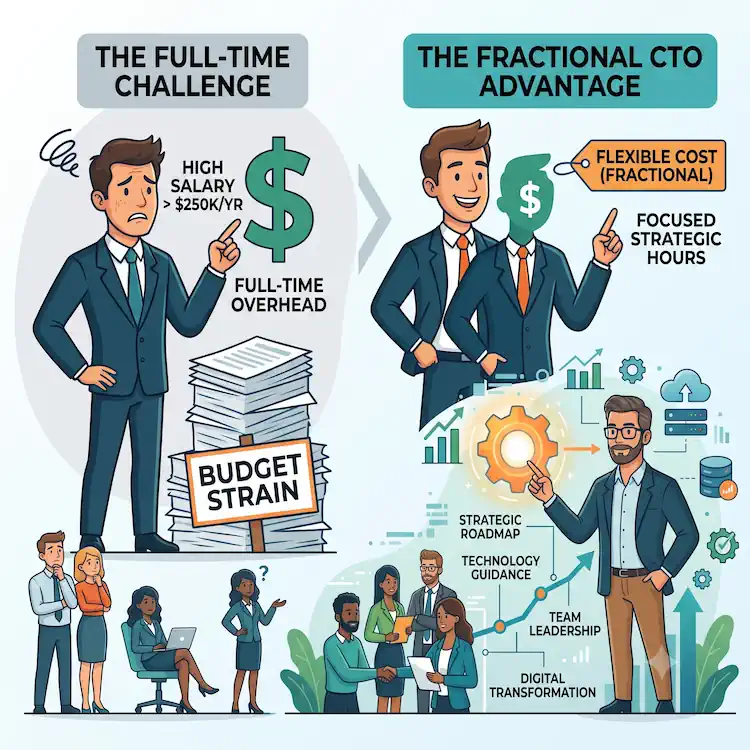
Hiring a full-time Chief Technology Officer (CTO) is out of reach for most small and mid-sized businesses (SMBs). In today’s competitive talent market, executive compensation for a seasoned technical leader routinely exceeds $250,000 to $350,000 annually, and that is before factoring in performance bonuses, healthcare, equity grants, and recruiter fees. For a growing business watching its cash flow, that kind of fixed operational expense is a massive pill to swallow. Yet, technology challenges do not wait until you hit a certain revenue threshold or headcount.
The problems a CTO solves, misaligned technology spend, fragile software architectures, scaling bottlenecks, security vulnerabilities, and vendor lock-in, don't care about your company size. If you rely on software, cloud infrastructure, or digital channels to drive revenue, you face enterprise-grade tech problems from day one. The solution isn't to cross your fingers and hope your lead developer can figure out executive strategy on the fly. The solution is Fractional CTO Leadership.
What Is a Fractional CTO?
A Fractional CTO is a veteran technology executive who embeds in your business on a part-time, retainer, or project basis. Rather than burdening your payroll with a multi-six-figure executive salary, you tap into executive-level expertise precisely when and where you need it. Think of a Fractional CTO as a strategic partner who brings the battle-tested playbook of a corporate tech executive, but with the agility and flexibility required by a growing mid-market business. You gain access to high-level architecture planning, board-level communication, and operational guidance—without the long-term financial commitment of a full-time hire.
The Hidden Cost of "Snoozing" Strategic Tech Leadership
When SMBs realize they cannot afford a full-time CTO, they typically default to one of three risky workarounds:
- Promoting a Senior Developer Too Soon: Your best engineer is fantastic at writing code, but managing a $500,000 tech budget, negotiating vendor contracts, and presenting to a board of directors require an entirely different skill set.
- Outsourcing Strategy to Agencies: Dev shops and agencies want to build software. However, their primary incentive is to bill billable hours, not to streamline your operations or keep your long-term maintenance costs low.
- The "CEO as CTO" Trap: Founders and CEOs often end up managing software projects, reviewing cloud bills, and managing developers themselves. This pulls leadership away from core business growth, sales, and capital allocation.
What You Actually Get: Core Responsibilities and Deliverables
When a Fractional CTO steps into your organization, they do not just offer advice from 30,000 feet—they roll up their sleeves and build governance, processes, and technical strategy inside your business.
- Technology Roadmaps Tied Directly to Business Goals
A software architecture should never exist in a vacuum. A Fractional CTO ensures that every line of code written and every tool purchased maps directly to a revenue objective or operational capability. They convert vague business goals ("We need to scale sales by 50% this year") into concrete technical milestones ("We need to automate CRM data pipelines and refactor our database architecture to handle 5x user volume"). - Deep Vendor Audits and Cost Recovery
Most growing companies are hemorrhaging money on redundant SaaS subscriptions, over-provisioned cloud infrastructure (AWS, Azure, GCP), and inflated agency retainers. The Reality: A thorough technology and vendor audit routinely recovers 15–30% in wasted spend within the first 60 to 90 days. A Fractional CTO reviews every contract, cuts unused software licenses, renegotiates cloud tiers, and holds third-party vendors accountable to strict SLAs. - Engineering Talent Vetting and Leadership
Hiring engineers is notoriously difficult for non-technical leaders. Candidates often talk a great game, but evaluating code quality, system design capabilities, and true problem-solving skills requires executive-level technical insight. A Fractional CTO designs your hiring funnel, conducts technical interviews, and establishes engineering standards. If you use external dev agencies, they act as your internal advocate to ensure software is built correctly, securely, and on schedule. - Security, Compliance, and Risk Readiness
Data breaches and compliance oversights can ruin a mid-sized business overnight. Whether you need to prepare for SOC 2 compliance, HIPAA, GDPR, or simple ISO standards, a Fractional CTO conducts risk assessments and implements industry-standard protocols. They make sure your customer data, IP, and digital assets are locked down before a auditor or hacker points out your weaknesses.
Comparing Your Options: Full-Time vs. Fractional vs. Agency
To understand why fractional executive models have become so popular, it helps to compare the primary paths available to a growing company:
| Metric / Feature | Full-Time CTO | Fractional CTO | Software Agency |
|---|---|---|---|
| Annual Cost | $250k‐$400k+ (Plus Equity & Benefits) | $30k‐$90k (Based on actual usage) | Variable ($150‐$250/hr) |
| Strategic Focus | High (Internal focus) | High (Objective & Battle-tested) | Low (Focused on scope/deliverables) |
| Flexibility | Low (Long-term commitment) | High (Scale hours up/down) | Medium (Project-based contracts) |
| Speed to Value | Slow (3-6 month recruitment process) | Immediate (Plugs in within days) | Fast execution, slow strategy |
| Business Alignment | High | High | Low (Biased toward billing hours) |
Flexible Scaling: Pay Only for What You Use
The fundamental beauty of a fractional engagement lies in its flexibility. Your business needs fluctuate throughout the year, and your technical overhead should reflect that reality.
- Early-Stage or Stable Operations: An established company with a smooth-running tech team might only require 10 to 15 hours a month. In this capacity, the Fractional CTO provides high-level mentorship, conducts monthly budget and security reviews, and keeps the strategic roadmap on track.
- Active Platform Migrations or Scaling Phases: A business undergoing a legacy system migration, preparing for a fundraise, or rebuilding its core product might ramp up the engagement to 30 to 50 hours a month.
- Post-Project Normalization: Once the critical milestone is completed, the engagement seamlessly scales back down—saving your operating margin.
Real-World Scenarios: When Should You Hire a Fractional CTO?
If you are unsure whether your business is ready for fractional leadership, consider these common triggering events:
- Scenario A: The Agency Hand-Off
You hired an external agency to build your MVP or core software platform. The project is finished, but now you need to bring development in-house. A Fractional CTO maps out the transition strategy, recruits your first full-time internal developers, and ensures a seamless IP transfer. - Scenario B: Cloud Bills Are Out of Control
Your business has grown, but your AWS or Azure bill has grown five times faster. A Fractional CTO analyzes your cloud architecture, eliminates wasted compute resources, implements auto-scaling, and slashes your monthly cloud spend without sacrificing performance. - Scenario C: Preparing for Due Diligence or M&A
You are preparing to raise capital or sell your business. Investors and buyers will perform rigorous technical due diligence on your software architecture, security practices, and IP ownership. A Fractional CTO audits your systems beforehand, remediating red flags so you get maximum valuation at the closing table.
Summary: Strategic Leadership as a Competitive Advantage
Technology should be an engine for business growth, not an unpredictable money pit. You do not need a full-time, $300,000-a-year executive sitting in an office 40 hours a week to establish world-class technology operations. By hiring a Fractional CTO, you bring battle-tested experience, financial discipline, and high-level strategic alignment into your organization at a fraction of the cost. You get the executive answers you need today, with the agility to scale your investment tomorrow.